There will also be music and…refreshments will be Girl Scout cookies, including Thin Mints! Don’t miss it!
Tuesday, April 7, 2015
Walking St Augustine…from Tolomato.
There will also be music and…refreshments will be Girl Scout cookies, including Thin Mints! Don’t miss it!
Tuesday, March 17, 2015
Looking for the Lost Chapel
As all Tolomato fans know, the cemetery was originally a “refugee Indian mission.” After the British Colonial Governor James Moore of South Carolina wiped out the Florida mission chain in attacks over a several year period, mostly notably 1704 and 1706, the few surviving Indians were brought into St Augustine and settled in five different villages, which were served by the Franciscans from what is now the St Francis Barracks. We know the locations of three of them: La Leche, La Punta and Tolomato, but there are two others in what is now Lincolnville whose exact location is unknown.
The villages were small, and Tolomato was probably the largest but nonetheless had fewer than 100 people or so in its heyday. They were mostly Guale Indians who had actually first been moved over a century earlier, during an Indian rebellion on the Georgia coast near their original home, and had spent almost 100 years living on a river that was known, of course, as the Tolomato River, which runs past today’s Guana River Preserve.
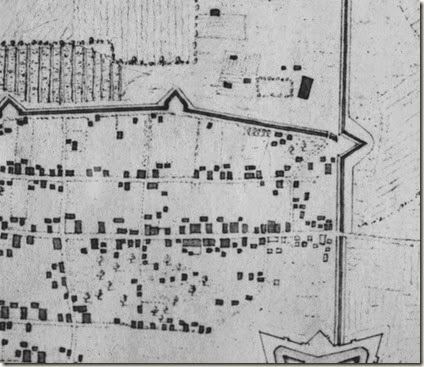
They were attacked by Moore, and in 1706, the Spanish governor issued an order calling the Indians into St Augustine and they fled to the city. Tolomato was located just at one of the west-facing city gates, near the redoubt where the cannons were, and was a safe location…although at least one of the Tolomato Indians was killed in the 1740s, defending the city against another wave of British-allied Indian attackers.
Above are two maps of St Augustine, the first by the Spanish engineer Juan Elixio de la Puente in 1764, and the other by the British engineer Moncrief in 1765. Tolomato would be at the upper right, outside the city walls and near the Cubo Line that went along today’s Orange Street.
We have virtually no other visual or archaeological records of the missions, except for a 1726 mention of a wooden chapel with a four-story stone bell tower at Tolomato. When the British arrived in 1763, the Spanish citizens, including the Indians, went to Cuba and abandoned their properties. The British took over and used the chapel for firewood, but they left the bell tower, and in describing his journey through Florida in the 1760s, the naturalist Bartram mentions the tall but narrow (about 20’ on each side) bell tower.
It stood until somewhere between 1793 and 1800, when it was taken apart so that the stones could be used in building the current Cathedral. One of the blocks of stone fell on the vault or grave of Fr. Pedro Camps, the Minorcan priest, and crushed it, leading to his reburial at the Cathedral in 1800.
But we have one question: Where exactly was the Franciscan chapel?
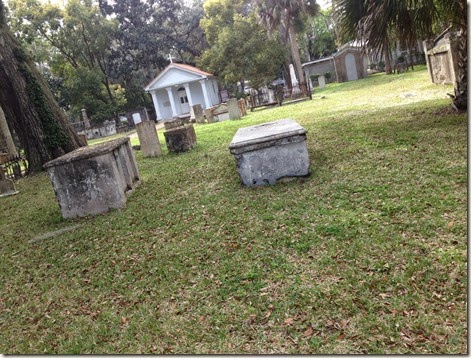
It was not located where the current Varela Chapel is located, because that piece of land was bought in 1853 specifically for building the chapel. And looking at the maps, it seems that the chapel was not even in the center of the Indian village. The de la Puente maps of the 1760s show it as a little northeast of the center of the modern cemetery, and one map shows it with another structure joined to it like an ell – this may have been the belltower joined to the chapel.
So the long and the short of the story is that we’re looking for any trace of the bell tower. But …GPR to the rescue!
Then last week, FPAN’s Kevin Gidusko, shown above, came out with his GPR equipment – and we think we’re getting close. If you want to know more about it, come out and visit us this Saturday, March 21, and ask us where we think it was.
And if you’re interested in the Indian population, go to the Flagler College conference on the Yamasee Indians to be held on April 17-18th. You can sign up here: http://yamaseeconference.weebly.com/. Meanwhile, look at those little red flags…and wonder.
Tuesday, March 3, 2015
Connections and Coincidence?
Every year around this time, St. Augustine receives a visit from a group of delegates from our Sister City, Avilés, Spain. It is also, of course, the birthplace of our founder, the Adelantado Pedro Menéndez de Avilés, so it’s extra-special to us.
This year, the group consisted of Councilman Román Alvarez, who has visited us often and is a scholar of the history of St Augustine and Avilés, and representatives of a project dedicated to the building of a scale model of the San Pelayo, the ship that brought Menéndez to these shores in 1565. The purpose of the visit was to present this remarkable replica in a public unveiling at the Visitor Information Center, and below you see the group from Avilés flanking this beautiful (and carefully researched, extremely accurate) model of the San Pelayo.
You’ll also see members of the city government of Avilés, including the Mayor, Pilar Varela. Of course, having the last name Varela meant that she would have to visit the burial place of our most famous Varela, Father Felix Varela, who died in 1853 and was buried at Tolomato Cemetery. Naturally, we had to take a photo of Alcaldesa (Mayor) Pilar Varela standing in front of the commemorative stone set in the wall of the chapel.
We were intrigued: were they related? Felix Varela’s father, Don Francisco Varela y Pérez, was a military man from Northern Spain who had been stationed in Cuba, where Fr. Varela was born. The last name Varela is widespread in the northern part of Spain where Avilés is located. This region is known as Asturias, and the name is also found in Galicia and parts of Castilla. So we had great hopes that we would find a connection.
But alas – diligent Internet research turned up the fact that Francisco Varela was born in Tordesillas, Castilla, and therefore was probably not related – or certainly, not very closely – to Pilar Varela, whose family was from Asturias/Galicia. Nonetheless, there were some odd coincidences on the visit. When Mayor Varela read the stone that is set over the crypt and saw that Fr. Varela died on February 25, she looked up, amazed, and exclaimed that February 25 was her birthday! If Fr. Varela is ever canonized, the day of his death would be his feast day (the day he is celebrated on the church calendar), so she will be able to say she was born on the feast of St. Felix Varela. Not a bad coincidence at all.
Thursday, February 5, 2015
Flying Over the Fence
Last week, the TCPA had its annual meeting and benefit at the Mission Nombre de Dios Museum. Below you see Sister Bernard Joseph, who works at the museum, chatting with TCPA member Samuel Williams, who came all the way from Tallahassee. The photo was taken by member Norm Merski.
We enjoyed music by our official “chapel harpist,” Mary Jane Ballou, and great nibbles and sangria provided by Patty Kelbert, below, owner of Le Pavillon Restaurant.
TCPA Vice President Nick McAuliffe – who managed to escape having his picture taken - and Matt Armstrong, at left with Ryan Harke and Chad Light, gave a great presentation on the history of the wall and the fence throughout the centuries.
This served to highlight the title event of the evening, the presentation of Chad Light’s drone video that showed our beautiful cemetery early one bright fall morning.
For those readers not from St Augustine, Chad Light is also known locally as the Adelantado Pedro Menéndez de Avilés, because he is the actor – with a striking resemblance to paintings of Menéndez, shown above from the Wiki article on him – who plays our founder in the various historical reenactments that take place here in the city, such as the yearly Landing Day reenactment in September.
But Chad also has a production company and makes videos, and he offered to come out and fly his drone over the cemetery and produce a short video for us.
Here we see Chad with his drone, a large drone that he also uses as a boom and dolly for shots when he is filming historical productions. It is controlled with a joystick and can swoop way up – and then get down very close. TCPA Treasurer Janet Jordan took these photos on the day that he filmed the video.
In the video, you’ll see the drone – or rather, you’ll see what it “sees,” as it cruises the length of the cemetery and hovers over spots of particular interest. You’ll also see Janet Jordan standing in the doorway of the chapel…not even aware she was being filmed!
Chad showed this to the members and invited guests at the meeting and we were all amazed. We knew the cemetery was beautiful, but when you see it this way, from a drone’s eye view, you sense the harmony and tranquility of the site in a way that doesn’t happen from ground level. Click on the link below and enjoy the video.
Monday, January 19, 2015
Little Lambs
When visitors pass through the Varela Chapel at Tolomato Cemetery, they often ask about the “lamb on the book.” Of course, they’re referring to the carving on the front of the altar, created out of mahogany somewhere between 1853 and 1854 by Havana cabinetmakers specifically for the chapel.
This is a very ancient image that has appeared since at least the 6th century in Western art, and is known in Latin as the “Agnus Dei,” or “Lamb of God,” representing Christ and often the Last Judgment. The title “Lamb of God,” of course, comes from the Gospel of John, where John the Baptist says, “Behold, the Lamb of God…” Certainly, those with a literary, artistic or especially with a Sunday school background will recognize the book as the Book of the Seven Seals, the book of judgment, which is described in the New Testament Book of Revelations. The Lamb “that was slain” is mentioned numerous times in Revelations, which also declares that the Lamb will open the Book of the Seven Seals at the end of time.
The Lamb is often shown standing, supporting a banner bearing a cross, but there are numerous variations on the theme. The Tolomato Agnus Dei is holding a banner carved with the letters “AD” for Agnus Dei and looking triumphantly over his shoulder. This image seems to be a compromise between the standing lamb and the one we see below, which is a prostrate and not very triumphant looking lamb that appears on the back of a 19th century vestment on display in the Diocesan Museum at the Mission Nombre de Dios in St Augustine. It is done with beadwork and embroidery.
And that image itself almost seems as if it had been based on this very famous painting done in 1640 by the Spanish Golden Age painter, Francisco de Zurbarán, with its touching image of a lamb bound for the slaughter.
But there are other lambs at Tolomato that mean something a little different. In the cast-iron gate of the Hernández family plot enclosure, which we are in the process of restoring, you’ll find two lambs peacefully resting under a willow-tree beside a body of water. This was a very common image in 19th century funeral art, and in fact lambs still occasionally appear on modern monuments.
Here the lamb represents tranquility, innocence and peace. We also see a couple of doves flying upwards into the willow trees; doves are a very ancient symbol of peace. And the willow tree had come to be associated with mourning in 19th century art, probably because of its gentle, drooping shape and possibly because of a reference in Psalm 136 or 137 (depending on your numbering preference) to the Jews in their Babylonian exile, weeping and “hanging their harps on the willow trees.” Willows were also considered evocative because they grow near still and often dark waters, such as lakes or slow-moving streams.
So this brings us back to our literary, artistic or Sunday school background as we recall the 23rd Psalm, which begins with the words, “The Lord is my Shepherd,” and includes the line “He leadeth me beside still waters.” Now you know are the many meanings of Tolomato’s tiny flock of little lambs.
Sunday, December 28, 2014
A New Year for Two Old Cemeteries
Thursday, December 18, 2014
The Last 3rd Saturday of 2014
It’s the last 3rd Saturday of the year, Christmas is almost here, and once again we have decorated Tolomato for the season. We hung wreaths on the Varela Chapel last week, no easy task, since the columns in front are coquina faced with concrete, meaning that the traditional nail or hook is out. Last year we used fishing line looped around the top of the capitals, which fortunately are flat and have a ledge around the top – so we tried it again.
Still, it took three of us (Elizabeth, Matt and Janet, the latter of whom are in the photo), juggling the wreaths, tying the nearly invisible line…and then trying to get the wreaths winched up to the same height on both columns. But we did it!
We also placed poinsettias at a few of the more notable tombs, such as those of Bishop Verot and Fr. Miguel O’Reilly, and also in front of the sign honoring the many Minorcans buried at Tolomato.
This Saturday, December 20, is a third Saturday, so we’ll be open as usual and you can come and see these things for yourself. And feel free to bring along another poinsettia or two if there is any grave in particular that you wish to mark.
Another seasonal but less inspiring thing to keep in mind is that this is nearly the end of the 2014 tax year! This mundane consideration should make you wonder what Christmas gift you could give that might be tax-deductible, and of course, the Tolomato Fence would be a perfect recipient for such a gift. You can visit our website, www.tolomatofence.com , to make a donation, or if you wish to make a large donation contact us by email at board@tolomatocemetery.com to arrange it. Securities and all other forms in which you wish to donate are accepted, along, of course, with good old checks.
But whether you donate or not, consider stopping by to visit on Saturday from 11:00 am to 3:00 pm. Our “chapel harpist,” Mary Jane Ballou, will be playing carols, and Matt Armstrong will be lending his voice (and his guitar) to the festivities. Of course, there will be the usual tours and information…and there might even be homemade cookies for a few fortunate visitors!


