Sunday, December 10, 2017

Tolomato 2017 - Lights and Shadows

We're getting ready for our Annual Meeting this coming Saturday, December 16, from 4-6:00 pm, and all of you who get this blog post are welcome.  It's also our Christmas party, which we have outdoors at the cemetery, so dress warmly!

 But before we start marking our calendars, let's look at what has happened over the last year.  Blog posts have been a little scanty because we have had so many time consuming reconstruction tasks as a result of a hurricane named Matthew, followed in less than 12 months time by a hurricane named Irma, and the major focus was on those events.  Nonetheless, we had some real high points and great events in between all those consultations with fence companies, tree surgeons, etc.

In January, 2017 we started with a gloomy sight – a dark day with our proud red cedar sheared off at the top.  This was damage from Matthew in October of 2016, but most of the other damage had been remedied by then.

So the famous TCPA volunteers, docents and board members, such as Brooke and Janet, above,  got busy and we moved along with our usual Open Day and visitor schedule, having an average of 3-400 visitors on each Open Day over the spring and summer. We had some special spring events: the annual Minorcan Day in February, a visit from our Cuban archeological friends, and some interesting individual visitors. For example, we had two visitors from a historic cemetery in Roswell, Georgia, who told us the sad Civil War story of the lost women of Roswell.  And we had numerous descendants and other interested parties who came looking for genealogical information (which Louise Kennedy, and her new "genealogist in training," Joan, were happy to supply).


We had another big event in April, with the installation of the DAR marker for Juan Ruiz del Canto, a Spanish naval captain who assisted the Americans in the Revolutionary War. We now have three Revolutionary War figures marked at the cemetery: Don Juan McQueen, Juan Ruiz del Campo, and Francisco Xavier Sanchez.  St Augustine was under the British during the Revolution, so most of their activity took place elsewhere, usually on the seas.


We decorated for Memorial Day in May and in June we were ready for a CRPT (Cemetery Resource Preservation Training) event, showing attendees the cemetery and our preservation activities.  We also started a few projects aimed at furthering these ends: the improvement of lighting in the Varela Chapel and the installation of a large room-sized storage shed, given to us by the Cathedral for use as an office and materials storage space, on the grounds of St Benedict’s Church in Lincolnville. The lighting project is temporarily suspended, since Hurricane Irma made us realize that there are more pressing needs for the Varela Chapel. But the new TCPA “office” is moving ahead. The shed has been moved to a good location, insulated, supplied with shelving and lighting, and is now awaiting the installation of windows.  Below you see Barbara Wingo opening the door, and it is now keeping our papers and supplies high and dry.


In June, Elizabeth went to the conference of the Association for Gravestone Studies in Tuscaloosa, Alabama, and came back with all sorts of ideas, as well as having learned about "comb graves" (which we don't have here in Florida). At the moment, a group of Florida cemetery enthusiasts, including Shelby Bender, Emily Jane from FPAN, and Catherine Eddins from Tallahassee, are engaged in forming and planning the first program for the new Florida Chapter of the AGS.  More on that later!

Elizabeth also went on a quest to find the original Tolomato site. There is a site that is inaccurately known as Tolomato Island, near Darien, Georgia – which actually turned out to be the remains of a 19th century sugar mill, something that hasn’t stopped optimistic developers from using the name, as you see below  - but the verifiable site is the next photo, an idyllic location at what is now the Harris Neck Wildlife Refuge, near St Catherine’s Island in Georgia. Artifacts have been found, but the actual location hasn’t been determined; however, we’re getting closer. One of these days we'll know more.


August was a fairly quiet month, marked mainly by the visit of  And we were fortunate enough to have Emily Ford, from the New Orleans restoration company Oak and Laurel, come in and take a look at the Oliveros Papy vault, which is in serious need of preservation. We started work on this, and found that the descendants are interested...but then...Irma hit.


This time, the flooding seems to have been somewhat less of a problem than the wind. There was no damage to the markers, except that the sign you see below and the new bushes we had just put in, alas, are no more. They were pulverized by huge limbs that fell from the big oak tree near the gate. But the gate itself was spared, and the damage was cleaned up within little more than a month, although the tree near the gate will never look the same.


We were fortunate enough to have clean-up help from members of a men’s prayer group from a parish in Pennsylvania who wanted to aid post-Irma Florida, and wanted to help somebody who couldn’t pay them back.  So they called around to the cemeteries and found us. The two men, accompanied by Conrad from the local hostal, The Pirate Haus, wielded their chain saws and went through these huge limbs snicker-snack. Below you see Our Heroes, accompanied by TCPA members. Then the pros came in with their trucks and hauled off the mountains of debris.


Other lesser damage, such as the cracked NE corner of the new wall, is under repair. 

We were open again in October, and we had a huge event at the end of the month just to prove it. Florida Living History sponsored its Dia de los Difuntos event at the cemetery, and we hosted reenactors - such as James Bullock “being” Gen. Biassou and Fr. Medina “being” Fr. Varela – and even a short 16th century Spanish play presented by Theater with a Mission from Tallahassee. It was a great event, attended by some 700 people, and we expect to do it again next year.


In November, we also had another All Souls event, the annual blessing of the graves led by Fr. Tom Willis from the Cathedral. As always, the Minorcans, accompanied by Fr. Ed Booth, came to Tolomato for their usual November prayers for their Minorcan ancestors, as well as for a chance to view the new fence-donor plaque installed on the wall, as Menorcan Society President Rusty Hall is doing below. The other donor plaques are in the works and will be ready early next year.


Also in the fall, we had preservation activities with our Flagler College friends and a great visit from a group of 7th graders from FSDB (Florida School for the Deaf and Blind), who did rubbings and learned about the cemetery and local history.


We also conducted a condition survey of all of the features, and are preparing to work on a few especially threatened markers and vaults. In addition to the Oliveros Papy vault, we have other vaults that need attention (repointing of bricks, restoration of plastering, etc.), deteriorating metalwork, and our centerpiece, the Varela Chapel, which needs painting and moisture control. You’ll hear more about this next year.


Tolomato made it to the screen a couple of times this fall, with the cemetery being used as an (unidentified) backdrop for an episode of the PBS show “Secrets of the Dead,” and also being filmed for part of a series on the Minorcans in St Augustine.


Also in November, we were saddened to announce the death of one of our wonderful volunteers, Priscilla de la Cruz, whom many will remember from the front gate, where she greeted visitors wearing her famous top hat.  Requiescat in pace, dear Priscilla.


Finally, we made it to December.  To start, Janet decorated the chapel and the bishop with a wreath and poinsettias. Then, a couple of days ago, we had a group of Greek visitors from the Panhellenic Society in the far off Tampa-St Pete area, who laid a wreath and had an Orthodox memorial service at the tomb of Mary Darling, known in St Augustine for having been a teacher at what is now called the Oldest Schoolhouse. She was a member of the Genopoly family, which bears an Anglicized version of their Greek name, and thus a descendant of one of the “Greek Minorcan” families who arrived in St. Augustine in 1777.


 And now? The only thing left this year, of course, is our Annual Meeting and Christmas Party, which will be held on Saturday, December 16, at 4:00 pm just after the closing of the gates for our regular Open Day.  If you’re getting this blog post – you’re invited. There will be tasty goodies and beverages, a chance to meet fellow Tolomato fans, and you’ll get to hear more of the details on our important preservation plans for 2018. Naturally, you are more than welcome to become a member if you’re not already one, renew your membership if it has lapsed, and – most important – volunteer to be part of these exciting things next year!  We need you!


Monday, August 28, 2017

Finding Footstones

On our most recent Open Day, while seeking the shade of our trees on a blazingly hot day, a couple of our volunteers came across some footstones that had somehow become separated from their headstones but bore initials that might make it possible to identify them.  The result was some excellent sleuthing by Louise Kennedy, our TCPA Secretary and genealogical expert, and Nick McAuliffe, our Vice President and archeaologist.  And this is what they found...


First of all, what is a footstone?  Basically, it was just a small marker to indicate the end of the grave, and was placed at the opposite end from the headstone. It generally bore only the initials of the deceased, although occasionally it included the date of death. Footstones seem to have entered into common use in England in the 17th century, and many 18th century English cemeteries have them.  It is also thought that, in some places in England, footstones bearing only initials and placed at the foot of a burial without a headstone were used to mark the graves of felons.  But generally, they simply represented the termination of that particular individual's cemetery plot, and in fact, many of them were later removed to reduce cemetery clutter and make it easier to cut the grass.

Tolomato has a number of footstones, some of them nearly sunken into oblivion with only a tiny band of marble remaining, others with no identification at all on them, and a few others with initials but no identifiable headstones to associated with them.


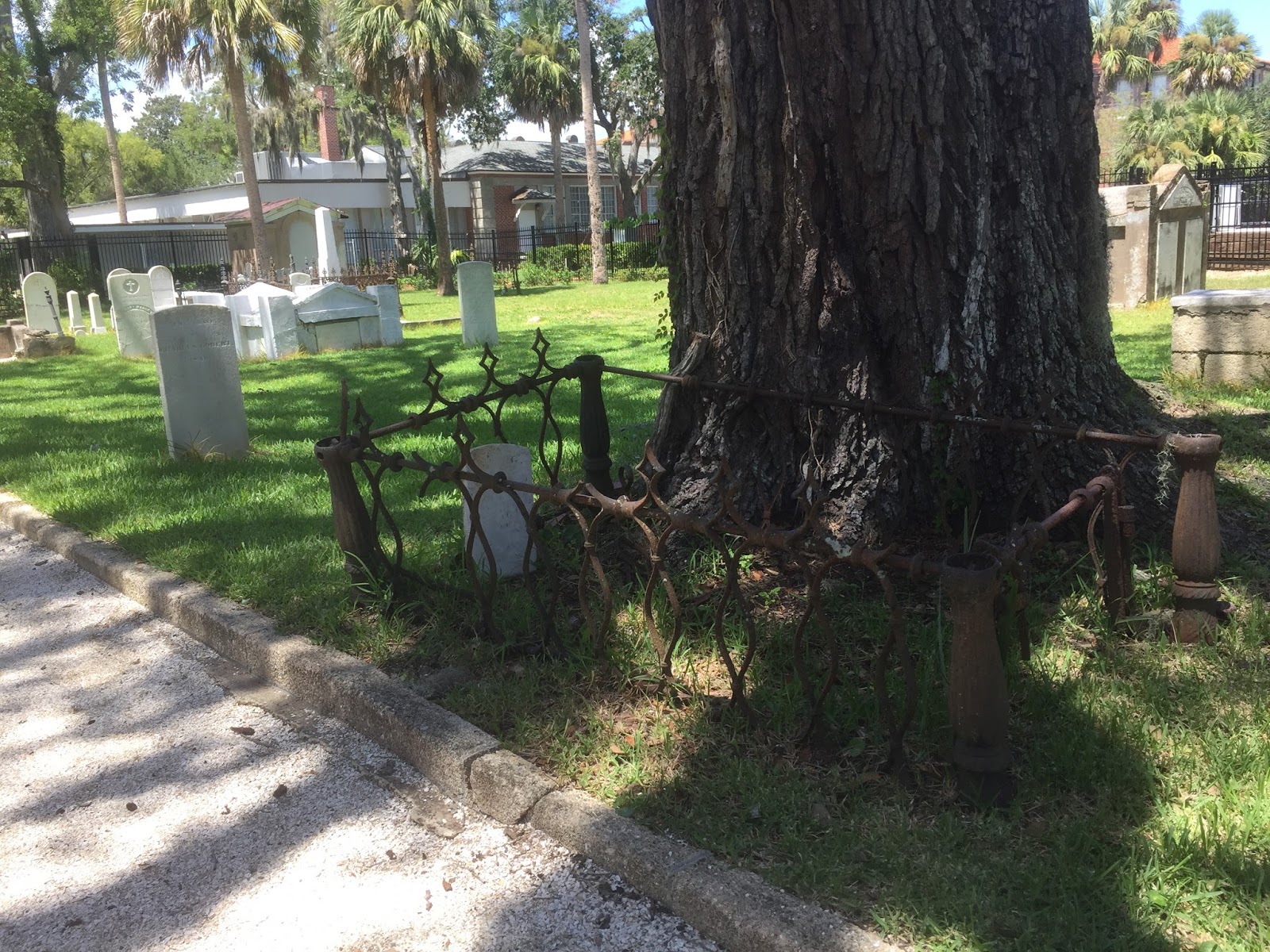
And then there are the wandering ones, such as the one Nick discovered, blackened and mildew-covered because of its long exile at the edge of the cemetery.  The marker was found near the remains of the cast iron grave enclosure on the south side of the cemetery.  When the new fence was put in, workers removed a tree - which as you can see, wasn't easy, since it had "swallowed" some of the metal parts of the enclosure - and we think that the stone was half-buried in the ground behind or very near to the tree.


It was certainly not the most legible thing, and it took us awhile to discern the letters E.F.M.  They are in the dark part of the marker. At first we weren't sure if the footstone was dark from earth staining, having somehow been turned upside down and stuck in the ground with the inscribed part at the bottom. But it turned out that the white part had actually been the buried part, protected from the elements and the pervasive lichen and mold.

Initially we hoped that we had found something associated with the grave enclosure, since we have never found any hints as to the identity of the person or persons buried there.  But Louise hit on the answer:  the footstone belongs to the grave of Fr. Edward Francis Mayne, priest at what is now the Cathedral from 1827 up to his death in 1834.  The footstone had somehow ended up about 30 feet from the headstone.


As you can see, Fr. Mayne has an imposing marker, nearly 6 feet tall, with "shoulders." (Yes, we plan to have it straightened.) Perhaps it was given to him to compensate for his trials at the Cathedral, since he was the parish priest during the "Wardens Period."  This refers to a period during the transition of Florida from a Spanish settlement to an American territory, when the resulting changes of diocesan authority and delays in assigning priests let to the establishment of a group of church wardens to run the parish.  Unfortunately, they seem to have been a fractious group, and drove more than one priest out of the parish.


When the Irish-born Fr. Mayne was assigned in 1827, he became embroiled in a conflict with the wardens when one warden, Antonio Alvarez, tried to prevent him from doing the burial rites for Jose M. Sanchez on the grounds that Sanchez was a Mason.  Fr. Mayne felt that the decision was his to make, after which the wardens locked him out of the church and he was able to conduct only a graveside burial service at Tolomato for Sanchez (who had been a political rival of Alvarez for the position of Mayor of St Augustine). In fact, the wardens would not let him reenter the church and he was forced for some time to say Mass in a private residence.

The struggle over his authority went from bad to worse over the years, even ending up in the secular courts, and was finally resolved at the end of 1832 during a meeting with the French-born Bishop Portier, Bishop of Mobile and Vicar of Florida, when the bishop threatened to excommunicate the wardens.  They settled down, but poor Fr. Mayne lived little more than another year, dying in January of 1834.

The Latin inscription on his marker records that he died in the 33rd year of his life and that he was a faithful pastor, "gentle and humble of heart."  So perhaps some recognition of his trials came from the faithful of St Augustine, and his beautiful headstone - which we plan to reunite with its footstone - represents this.

But that's not all!  Yet another grave enclosure yielded another footstone to study and once again, Louise Kennedy went into action.


This enclosure is under one of our two huge oak trees, and is slowly being pulled out of the ground by the tree. It contains some fragments of stone, along with a footstone that didn't belong there but was put into the ground in the recent past just to keep it from being run over by the lawn tractor.  And while nobody knows the identity of the "owner" of the enclosure - a relatively small enclosure possibly for just one burial - the footstone bore the initials C. D. G.  And who else could that be but Charles Dominique Gobert, whose simple but dignified and well-preserved headstone is located about fifteen feet away from the grave enclosure?

Like Fr. Mayne, he had a dramatic and conflict ridden life, and Louise uncovered his story for us.


Charles Gobert was born in France in 1767 but emigrated to the new United States and became a naturalized citizen in 1794. He started his life in the US as a merchant in Philadelphia, marrying the daughter of Lewis Ogden, an important figure in the War of 1812, and eventually moving with her to Spanish St Augustine. Unfortunately, he lost his fortune as a penalty for his involvement in a duel with a Spanish officer and returned north, this time to New York, where he filed for bankruptcy.  He seems to have moved around to various positions and then was employed as a civil engineer at the Washington Navy Yard, during which time he ended up defaulting on a contract for producing musket balls, perhaps because he was too busy with his own invention: a "hydro-war-ship."

In this tense period before and during the War of 1812, Gobert tried to interest the Mayor of Newark and other authorities in his "Machines for public harbor Defense."  He even wrote to President James Madison in 1814, shortly before the end of the war, to describe his project and get support. And while he got a cash advance from Newark for this work, he never seems to have delivered the product.  In fact, no plans for it have ever been found and it is not clear what this "machine for blowing up Ships of War" looked like or  how it functioned.

Gobert took off again and ended up getting arrested for treason after it was found that he was dealing with and sending clandestine communications to the British in the Chesapeake.  Somehow he seems to have gotten out of this predicament, and was merely jailed, once again, for bankruptcy, this time in Washington.  When he was released, he bounced around a bit, pursuing interests and seemingly phantom opportunities in Baltimore, Havana and New York.

Finally, in 1816, President Monroe accepted his claims of innocence of the charge of treason and the State Department restored his papers.


And then at last, in 1821, we find a mention of him in the "Florida Territorial Papers," where he appears as a translator and interpreter of French and Spanish.  The other mentions of him are in a census and a couple of civic and property records - and, true to form, in records of a 1826 lawsuit over rental payments.

Louise cites the report of the New York Evening Post:  "Charles Gobert, native of France, resident merchant in New York City, for the last 9 years residing in St. Augustine, died 26 March 1830."

And all this information was found by Louise from the finding of that small, stray slab of marble that was the footstone installed at Tolomato Cemetery 137 years ago.  So even the humble footstone deserves its measure of historical respect.


Monday, August 14, 2017

The Fair West

Occasionally we travel beyond our humble one acre at Tolomato to view the spreading cemeteries of other countries - or, in this case, of our own American West.  And even though we spent several hours at the 285 acre Fairmount Cemetery in Denver, Colorado, which includes an enormous public mausoleum, seen below, we visited only a fraction of its monuments.


Fairmount Cemetery as such was founded in 1890, but was in use well before that as the City Cemetery, founded in 1858 and incorporating yet another cemetery, Mount Prospect.  Its first burial was James (Jack) O'Neil, who died in 1859 in unfortunate circumstances, shot to death in a gambling argument. This was the Wild West, after all. Note that his gravestone, below, proclaims that he was MURDERED.

Perhaps because of burials such as this, the City Cemetery developed an unsavory reputation, and, as boom-town Denver became more prosperous and home to some very wealthy people, city fathers urged the founding of a beautiful "garden cemetery" in the style inspired by Paris' famous Pere Lachaise.  A new cemetery was founded on the site in 1890.  It incorporated several other cemeteries, and some burials were moved to Fairmount while others were moved away, and some of the burials from Denver's earlier cemeteries were left in place - under land that is the site of the Botanic Gardens and various local parks.

A German landscape architect, Reinhard Scheutze, was hired to design it and created a vast, rolling park that now has some 3,800 trees and thousands of markers and monuments.  The style in 19th and early 20th century Denver, oddly, was very French influenced, and many of the mausoleums and markers of the prosperous reflect this or display a Classical theme.  Anybody who was anybody  in Denver is buried here, and the names - Bonfils, Cheesman, Boetcher, among others, can be seen on the streets and important buildings of Denver.


Burials from the 1920's and 30's are often Art Nouveau in style, while some adopted the "Egyptian" style made popular after the discovery of King Tut's tomb in 1922.


And then there was the mausoleum, with its hundreds of niches and vaults - and the largest collection of stained glass in Denver!  An interesting fact was that in recent times, people had decorated the niches of their deceased with little personal items, such as eyeglasses or some other favorite or typical thing. These are called "grave goods" by scholars, and now appear even in niches holding cremated remains.


There were a couple of "markers" of truly monumental simplicity:  huge boulders of rough pink granite from the Rockies, such as you see below:


However, one of the most interesting things was the marker and monument of J.A. Falkenburg, founder of the Western branch of that famous insurance and burial society, Woodmen of the World. You may know them from their tree-trunk shaped markers, which can be found in virtually any cemetery in the country.


You can read the rather complicated history of the Woodmen here at the blog A Grave Interest, but suffice it to say that none of it would have happened without Falkenburg, shown below. But no tree trunk!  It looked as if the front of his granite plinth may once have had a tree-trunk fastened to it, or at least a plaque featuring their slogan, Dum Tacet Clamat, "Though silent, he speaks," but it was obviously lost at some point in the past and only a few bolt-holes remain.


But all throughout the cemetery, trunks of varying sizes, styles and materials appeared, reflecting the many forms this enduring symbol has taken over the years. In addition, there were more graceful markers with the symbol of a bird and a trunk - for the women's branch, the Women of Woodcraft. Perhaps these form the best monument to J.A. Falkenburg.


 Fairmount Cemetery is open for visitors at any time, and in addition, has a full schedule of tours and events sponsored by their volunteer group, the Fairmount Heritage Foundation.


Wednesday, May 24, 2017

Memorial Day History at Tolomato Cemetery

The cemetery was open for visitors last Saturday, and since we will not be open on Memorial Day, one of our members, Ray Hinkley, took advantage of the time to set out American flags in front of the markers of our veterans...of many wars.

Going chronologically, of course, we start with the American Revolution.  We did a longer post on this a couple of weeks ago, so you will probably remember that Florida was actually under the British during the period comprising the American Revolution (1775-1783). In fact, the reason the British left St Augustine, which they had gotten away from the Spanish in 1764 as a result of the French and Indian or Seven Years War, was the American victory and the terms of the Treaty of Paris in 1783.  This required them to surrender their territory in the new United States and return territories taken from other colonial powers to their earlier owners.  Thus Florida returned to Spain, and was Spanish for another 40 years, until it became a US territory in 1821.


So there were no battles here and no American soldiers here, but some of those buried at Tolomato Cemetery nonetheless did participate in the American Revolution, so we felt they deserved commemoration.  Above you see flags in front of the DAR markers for don Juan McQueen - who, as a merchant captain with business interests in Paris, carried secret letters back and forth between General Lafayette in France and General George Washington - and Juan Francisco Ruiz del Canto, who provided crucial information and aided Spanish Governor Bernardo de Gálvez in the crucial 1781 Battle of Pensacola, which kept the British from taking over parts of the lower South.  Spain had become an ally of the Americans in 1779 and at that point possessed Louisiana and had a regiment based there. Gálvez defended or took Baton Rouge, Natchez, Mobile and Pensacola, and was considered so important by George Washington that he invited Gálvez to march at  his right hand in the grand parade in Philadelphia on July 4th, 1783.  Below, reenactor JosĂ© Gueits appears in an 18th century Spanish uniform such as Gálvez' men might have worn.


We couldn't find anyone buried at Tolomato who had participated in the War of 1812, during which time St Augustine was Spanish, so we had to jump ahead to the Civil War.


And here we have both sides represented: above we see the markers for the Confederate veterans buried in the cemetery (although not in those exact locations).  Colonel John Masters of the Sons of the American Revolution made it his life's work to find unmarked Civil War soldier graves throughout Florida, searching through burial records and VA records, and then obtained and installed VA markers for them. These markers were installed in the year 2000.  The names on them are old St Augustine names, some of them Minorcan names while some of them, such as Bravo, are even First Spanish Period names.

The other side of the Civil War also appears in the two markers below, one for Frank Papy and one for Hector Adams.  They were both members of a regiment of the USCT, or US Colored Troops, units opened by the Union Army for the recently emancipated African Americans; sometimes these vets are referred to as the Freedmen.  This particular regiment was originally from South Carolina, but the recruiting station was at the Castillo, and Frank Papy, a waiter, joined when he was 19 while Hector Adams, a wagon driver, joined at the age of 50.  We know a fair amount about these men from their VA records. 


St Augustine had a number of other Freedmen, and there are more burials at the Mission Nombre de Dios, which was used as the parish cemetery during the 15 or so years between the closing of Tolomato Cemetery in 1884 and the opening of the current Catholic cemetery of San Lorenzo in 1898.

And finally, since Tolomato closed before any of the "Great Wars" of the 20th century, we have a veteran who died far from home, Patrick Keenan, born in Ireland. He joined the Army in Pennsylvania during the Civil War but remained in the service as Regular Army and was stationed with the 5th Regiment here at the Castillo.  He died of tuberculosis in 1877 at the age of 33, and his fellow soldiers in his new home provided this stone for his grave.  The inscription reads: "This Stone is Erected as a Tribute of Respect by his Comrades of Battery K, 5th Artillery."


Thursday, May 11, 2017

Tolomato Cemetery and the American Revolution


The Daughters of the American Republic (DAR) recently gathered again at Tolomato Cemetery  to dedicate the marker of a DAR American Revolutionary War Patriot - that is, a DAR member's ancestor who participated in the American Revolution in some way - buried in the cemetery.  The first commemoration, you will recall, was for Don Juan McQueen, who was from South Carolina but spent much of his life in St Augustine and is buried at Tolomato Cemetery.  He aided the American side by carrying messages from General Washington to General LaFayette in France when he made merchant voyages back and forth to Paris. 


But now we have a very different story.  The DAR's honoree this time was Juan Francisco Ruiz del Canto y Escalona, a Spanish citizen born on Spanish Street in St Augustine in 1730 during the First Spanish Period.  He was of Spanish descent on both sides, although his mother was a 6th generation St Augustinian.  Above we see all of our "Revolutionary War" corner, with markers for Don Juan McQueen, Francisco Sanchez (near the vault on the right) and our newest marker, for Ruiz del Canto.

Juan Francisco Ruiz del Canto was responsible for the supervision of the Castillo de San Marcos, and when the Spanish left St Augustine in 1763, he was appointed by the Governor as one of the group of three Spanish citizens who oversaw the mapping, sale and settlement of Spanish properties with the incoming British.  One of the other members of this little group was Juan Jose Elixio de la Puente, famous for his 1764 map of St Augustine.  Below, Elizabeth Gessner stands with a group of "Spanish soldiers" wearing uniforms of the First and Second Spanish Periods (1565-1763, 1784-1821).


Ruiz del Canto made many trips from Cuba to St Augustine for these purposes and also had many contacts among the local Indian tribes, which enabled him to dissuade the Indians from supporting the British in the growing conflict and secure their neutrality.  In 1779, Spain joined the American side in the war against the British and Ruiz del Canto served with the Spanish.  In 1780, he captured a small British sailing craft and took its captain and crew as prisoners to Cuba.  When interrogated by the Spanish, the captain, British Captain. Robert Holmes, revealed information about British troop locations and naval presence in Pensacola. This proved crucial to the planning of the successful Seige of Pensacola by Spanish General Bernardo de Gálvez.  The re-taking of Pensacola by Spanish forces - which included a regiment from Majorca and one of the Hibernian (Irish) Regiments under the command of General Arturo O'Neill - drove the British out of West Florida. At the end of the American Revolution, the area was returned to Spain, which granted Americans access through it to the Mississippi River.  Below you see the reenactors as well as members of the current Spanish military hold the flag of the Louisiana garrison, since Louisiana was Spanish at the time of the activities of Ruiz del Canto.


Our DAR patriot made his way back to St Augustine after the Spanish returned in 1784, settling with his second wife Francisca de la Hita Salazar (also St. Augustine-born) and their children first in a house on Hospital (now Aviles) Street and then on St George Street, in the Avero house, which is now known as St. Photios Shrine and had been the residence of Fr. Pedro Camps after the Minorcan arrived during the British Period.

See how well everything ties together in our complicated past!


The research on Ruiz del Canto was done by the  very gifted and dogged historian for St. Augustine's Maria Jefferson DAR Chapter, Lynne Cason, shown above in front of the honor guard as she tells the story of Ruiz del Canto.  When the DAR decides to dedicate a marker, they do extensive research on the honoree, and in addition, find a DAR member descendant to represent him. In this case, they found Teresa Sardinas, shown in the photo below, who came up from South Florida to be present at this honor.  She is sitting with representatives of the Spanish military, who came from Tampa to be present at this recognition of Spain's aid to the nascent US during the Revolution.


The DAR had members from the local and far-flung chapters in attendance for this important event.  It was a very photogenic and well attended event! TCPA Secretary Louise Kennedy took most of the photos in this post, and others were taken by member Joan Roberts.


Because of the military importance of Juan Francisco Ruiz del Canto's actions, there was a delegation of Spanish military representatives in attendance.  Here you see Lt. Colonel Gonzalez Prada addressing the crowd with some interesting details of Spain's activities during the American Revolution.


The DAR had also invited "representatives" of the Spanish military of the past:  two groups of reenactors. Dr. Warren Feldman and Jason Davis were our First Spanish Period soldiers, while John Cipriani and Jose Gueits Romero represented the Second Spanish Period. 


Fr. Ed Booth, a longtime friend of Tolomato Cemetery, gave the invocation and blessed the marker.  Here he begins the prayers as Teresa Sardinas waits to unveil the marker (under the blue tarp).


The American Revolution took place during the British Period in St Augustine, so of course St Augustine had no participation on behalf of the American side.  In fact, it functioned mainly as a prison for Americans captured at sea or in battle further north.  They were held in the Castillo or under house arrest at various other points around town.  But the Treaty of Paris that ended the Revolution required England to vacate territory it had gotten from other colonial powers, and Florida then reverted to Spain for another 40 years - which allowed our Revolutionary Patriot to return to St Augustine, live out the rest of his days here (resuming his work at the Castillo), and be laid to rest in Tolomato Cemetery in 1802, over 200 years ago.


And now Tolomato Cemetery has it's very own "Revolutionary War" corner, with markers for Don Juan McQueen (installed by the DAR), Francisco Xavier Sanchez (installed by the Sons of the American Republic) and Juan Francisco Ruiz del Canto (DAR marker), all of them reminding us of the very interesting and little-known story of Florida during the American Revolution.