Tuesday, October 20, 2015

Memory Eternal–Pat Kenney


Tolomato Cemetery is, well, a cemetery, and thus is all about death. But these are remote deaths, the last one some 125 years ago, and while we tell the stories of the people buried there, probably most of us skip over the fact that one day none of us will be there to tell that story.

Pat Kenney

Two weeks ago, we had our first death in the TCPA with the death of our dear docent and board member Pat Kenney, who was also going to be the editor of our first book on the cemetery. She died about a year and a half after having been diagnosed with cancer. Pat was a strong, positive person and even after her surgery was hoping to resume her work on the book project.

Pat was born in New York but brought up in St Augustine and spent most of her life in the St Augustine/Jacksonville area, so she knew many descendants of those buried at Tolomato, and was always eager to help them connect the dots on sometimes sketchy family records. She was always very much a part of St Augustine. When her family requested that memorial contributions be made to Tolomato Cemetery – a large number of the donations came from her classmates at St Joseph’s Academy, Class of ‘66.

She had a real passion for helping people to know things! Pat was often to be found at the back of the cemetery near the chapel, either working with Louise on the genealogy table or simply explaining that area to the visitors.  She was very shy about photos, so the only photo we had was one where she was leading a tour and had her back to the camera…but her daughter, Kelly, supplied us with a photo of Pat.

Pat Kenney photo

Our very first meeting with Pat came from a visit to Tolomato Cemetery in early 2011, when she visited the cemetery with a group of attendees of the Franciscan History conference at Flagler College. She then contacted us to find out more and to arrange for a visit with some of her students from FSCJ/Deerwood, where she taught at that time. The first time most of us met Pat was when she brought this group of students to the cemetery in May of 2011…and we were all completely impressed by the way she had prepared her students – many of whom were in the mortuary science program at the State College - and how concerned she was about them and their understanding of this site and about burial practices and respect in general.

Later, she contacted us about bringing another group from UNF, where she was then teaching, and also about getting more involved in the activities at the cemetery. And that was how Pat became a docent and then a board member and then the committee chair and editor for the projected book on the cemetery (which will be dedicated to her when it is eventually produced). 

She wanted to come back after her surgery, but that soon became impossible. Yet Pat was still a presence in the cemetery. So now all we can say is “We miss you, Pat.”

Tolomato Postcard 2

This is Pat’s obituary from the Florida Times Union:

image

During the active time of Tolomato Cemetery, the funeral chant in the Catholic Church was the “In Paradisum.” The English translation is: "May the angels lead you into paradise; may the martyrs receive you at your arrival and lead you to the holy city Jerusalem. May choirs of angels receive you and with Lazarus, who once was poor, may you have eternal rest." 

This is the Latin, which you can hear by clicking here: In paradisum deducant te Angeli; in tuo adventu suscipiant te martyres, et perducant te in civitatem sanctam Ierusalem. Chorus angelorum te suscipiat, et cum Lazaro quondam paupere æternam habeas requiem.

Thursday, September 10, 2015

Farewell to the 450th

As we hope everybody knows, this weekend was the celebration of the 405th anniversary of the founding of the city of St Augustine with the landing of the Adelantado Pedro Menendez de Aviles. Of course, Tolomato Cemetery wasn’t established at that time, and it was not for another 150 years that the refugee Indians from La Natividad de Nuestra Senora de Guadalupe de Tolomato would be settled on the site of the current cemetery.  Still, the historical connections run back through the families buried there, and also reflect the continuing story of St Augustine.

In fact, Tolomato Cemetery hosted one of the few events of the weekend that had any connection with St Augustine’s real history.  The cemetery was the objective of a procession from St Photios shrine to commemorate the Greek arrival in St Augustine and to bless the graves of all of the St Augustinians buried there.

IMG_6215

Greeks? At Tolomato? Yes, St Augustine had a fairly significant Greek population in the 18th century because of the arrival of the Minorcans in 1777.  While most of the Minorcans were actually from Minorca, many were from other parts of the Mediterranean, including Greece. The name of the group comes from the fact that Dr. Andrew Turnbull, the British-period indigo plantation owner, shipped the group out from the formerly Spanish island of Minorca, which was controlled by the British at that time as a result of the same war that had given them control of St Augustine. 

Dr. Turnbull had been the British consul in the Ottoman Empire prior to coming to the American continent, and had married a Greek woman from Smyrna.  This is the reason that he named the colony New Smyrna Beach.

IMG_6222

Dr. Turnbull felt that Greeks would be able to tolerate the heat of Florida better than other groups of laborers that the British used.  So they set off for Greece to recruit laborers, but for various reasons were not able to get the number of workers they needed.  So they seem to have sailed the Mediterranean, gathering up immigrants from Sardinia, Sicily and other parts of Italy, and even a Corsican or two…and of course, Minorcans. 

Eight years later, the survivors of this group would arrive in St Augustine and become a distinctive and foundational part of the city’s life.

This year, the commemoration of the Greek arrival was particularly spectacular. The above photos, taken by Nick McAuliffe, give you some glimpses of the celebration, which was organized by our good friend Polly Hillier of St Photios Shrine, whom you see above, addressing the group.  Brooke Radaker took the photo below, where you see the members of the Cantorae St. Augustine, directed by Mary Jane Ballou, singing a Greek hymn as the procession enters.

cantorae

We had a beautiful gathering of clergy, walking together to bless the graves in this special place and showing once again the wide diversity of St Augustine’s founding population.  Here we see the Orthodox Bishop Demetrious with the Catholic Bishop of St Augustine, Bp. Felipe Estevez (who was born in Cuba, a place closely tied to St Augustine), Fr. Tom Willis, who is the rector of the Cathedral, and Fr. Nicholas Louh of the Greek Orthodox Church.  Louise Kennedy took the photos below.

2015-9-15 Greeks 037

They were accompanied by official representatives of the Greek community, and Mayor Nancy Shaver initiated the event by reading a proclamation honoring the Greek landing day. Below, Fr. Nicholas places a flower on a vault.

2015-9-15 Greeks 032

There were so many striking photos it was hard to know which to pick.  Here are the two bishops again, in front of the Varela Chapel.

  2015-9-15 Greeks 025

The procession included Greek dancers, who later performed on the stage on the Plaza.

2015-9-15 Greeks 035

The grave blessing at Tolomato was actually part of a larger Orthodox memorial service, which had begun at St Photios Shrine with the prayers and hymns that are traditionally used in this service (which also form part of the funeral service).  It concluded at Tolomato with the blessing and further hymns, and then with something that most non-Greeks were seeing for the first time:  the serving of kolyva. This is a mixture of cooked wheat berries (whole grains of wheat), sesame seeds, nuts, raisins or other dried fruits, pomegranate seeds, sugar or honey and bitter spices.  It is blessed and served in small cups after a memorial service and on similar occasions, since wheat represents the Resurrection and the symbolism of sweetness and bitterness is deeply rooted in religious imagery.  It is a very ancient tradition, and appears not only in Greece and the Mediterranean traditions, but among all of the Slavic peoples as well.  Here’s a sample…I wish we had some sort of tasting device on our IPhones, because it is actually very tasty!

IMG_1581

So that was how we celebrated the 450th at Tolomato Cemetery – with a little real, living history!

IMG_6214

Monday, August 17, 2015

Sister City Cemeteries

Aviles, Spain is one of St Augustine’s sister cities – and perhaps even the most important one, since our 16th century founder, Pedro Menéndez, was from Avilés.  To commemorate this connection during this 450th anniversary year, several members of the St Augustine Archaeological Association took a trip to Aviles to view archaeological work being done in that city.  Our generous hosts showed us everything from prehistoric cave paintings to Roman ruins to pre-Romanesque churches, and even took us down into a modern archaeological site, a 19th and early 20th century coal mine that has been excavated and turned into a museum of early industry.  Next year, some Avilés archaeologists will come to St Augustine, and we’ll show them what we have…not as old, by any means, but certainly interesting.  In this photo, you see some of the group, along with our host, Román Álvarez, surveying modern Avilés.

Aviles View

Naturally, one of the things we will show them is Tolomato Cemetery, since we hope to have even more information about it by next year.  Work is due to begin soon on the repair of the fence and wall, and the city archaeologist, Carl Halbirt, will do a small dig along the front wall to see what information he can…dig up. Groan – I had to say it! 

Next year, a graduate student is also planning to base his thesis on a Ground Penetrating Radar study of Tolomato, looking for the footings of the old mission chapel and bell tower as well as any other significant archaeological record that he can find.

But as we prepare to investigate Tolomato for our visitors, it’s worth spending a few minutes talking about the cemeteries of Avilés. 

Padres Franciscanos

As in St Augustine, pre-19th century burials were under or around the church.  In the above photo, we see the church where Pedro Menéndez is buried, in a marble urn high up on the wall; it is now known as the Iglesia de los Padres Franciscanos, but during the time of Menéndez, when it was his parish church, it was known as San Nicolás.

Iglesia Sabugo

In this photo, we see the side of a 13th century church, with gravestones clearly visible in the yard next to it.  This is the old Iglesia de Sabugo; the latter was the name of the village where Menéndez was born.  It was originally a separate fishing and maritime trades village located next to the larger commercial town of Avilés, but now it is simply a neighborhood in Avilés. The church is now closed, but archaeological work has found many burials around the church and under the floor.

And then we come to the world’s largest, most dramatic angel…as the 19th century cemetery arrives in all its glory!  This angel points to Heaven from its seat on the casket of the Marquise de San Juan de Nieva at the Cemeterio Municipal de La Carriona on the outskirts of Aviles.  This dramatic statue by 19th century Asturian sculptor Cipriano Folgueras was even a finalist in a recent Spanish cemetery art competition.

Angel

This cemetery was opened in 1890 when, as in St Augustine, burials were forbidden within the city of Avilés for health reasons.  It contains many huge monuments, some of them by well-known artists and sculptors of the time, as well as fields of more modest stones. Below is the grave of a local poet and author, Armando Palacio Valdés, where a mourning woman sits next to an excerpt from one of his poems, in which he urges the passer-by to leave a branch of honeysuckle in his memory. Someone has, in fact, left some flowers at the foot of the monument.

IMG_1310

Below we see a crypt with stairs, so that people could descend to pay their respects to the deceased who were buried in niches under the crypt.

Crypt

The cemetery is still in use and has regular burial services.  There is a chapel in the center of the cemetery that contains a catafalque, where the casket is placed during the funeral Mass or service. 

Chapel

The cemetery is located on the top of a hill and is a dramatic sight in its own right.  Interestingly, it also has an interpretation center, and offers guided tours and programs on the cemetery, cemetery art and related matters.

Fence

But you don’t have to go all the way to Avilés if you’d like to find out more about our Sister City’s cemetery, which goes by the acronym CicLaC. All you have to do is click here for their Wikipedia site (in Spanish, of course) or here, for the very interesting site of the Association of Significant Cemeteries in Europe, an EU initiative which has links to fascinating cemeteries all over Europe.

CicLaC

Monday, July 13, 2015

An Unexpected California Cemetery

Last week, I had to make an unexpected trip to Santa Rosa, California, and while there, I came across a completely unexpected cemetery.  Called the Santa Rosa Rural Cemetery, it is located in what may once have been a rural area, but certainly now appears to have been an established residential area for some time.  At first glance, it seems to serve more as a park for local residents than a cemetery – but as I wandered through this hilly, oak-tree covered refuge, I realized that it had indeed been a busy 19th and 20th century cemetery and in fact was even still in use as a burial place.

IMG_0527

Santa Rosa is about 75 miles north of San Francisco, and the area was home to the Pomo Indians before the arrival of Europeans. Since the 18th century, there had been Spanish and Mexican ranchers in the area, which has its own Matanzas Creek – so named because the ranchers used to slaughter cattle at a point along the creek.  There were even Russians, strayed over from the Russian settlement at Fort Ross.  But the first formal settlement (1836) was the homestead of the Carrillo family, related to General Vallejo, founder of Sonoma and a man who had passed through three citizenships (Spain, Mexico and, finally, after California became a state in 1850, the United States) by the time of his death.

IMG_0530

The town developed rapidly after statehood, and the cemetery was officially established in 1854.  It expanded and other adjoining plots of land were bought, although they were considered separate cemeteries and it was only sometime after the 1930s that they were all brought together as the Santa Rosa Rural Cemetery.  There are over 5200 burials, and the plots are mapped and identified. While the cemetery is technically closed, the families that hold original titles to the plots are allowed to continue to use it for burials.  Below is a modern marker.

IMG_0548

But the 19th century markers were the really interesting sights.  The cemetery has an unusual number of Civil War veterans, some of whom had volunteered from California and others who had emigrated to California from both North and South after the war. During the war, there was considerable conflict, although no fighting, in California between supporters of the South (who were more numerous in Southern California) and supporters of the Union. Most of the 160 or so Civil War burials are those of Union soldiers, although there are also about 15 Confederate soldiers buried at the Rural Cemetery.  Many of those buried here fought at Gettysburg, and a Gettysburg monument was even installed in the cemetery in 1910.  Tolomato visitors will recognize the old-style Veterans Administration marker belwo.

IMG_0553

I was also struck by a very touching symbol that appeared on numerous markers: two hands clasping, sometimes in front of a cloud or nimbus-like shape.  This represented a farewell to earthly life and a welcome into eternity.

IMG_0547

If you look closely, you will notice something that was not present on all of them and had a slightly different meaning. The cuff on the sleeve of one of the hands looks like a man’s shirt-cuff (sometimes even with cuff links!) while the cuff on the other hand appears to have lace or braid at the cuff, such as a woman’s dress would feature. This meant that the burial site was that of one or both of the members of married couple, with one of them welcoming the other to their reunion in their eternal home.

IMG_0540

There were also lambs, birds and other symbols that had been meaningful to the families of the deceased, and I spent quite some time searching out the different symbols in the dappled light.  And I certainly wasn’t alone.  The cemetery was full of strollers, and on the way out, I discovered from a bulletin board set near the gate that it has a full program of activities.  Like Tolomato, it is maintained and curated mostly by a volunteer association, although the City of Santa Rosa helps with major projects.  And like Tolomato, it has docents – and some really neat activities!

IMG_0557

So, in the unlikely event that I have to go to Santa Rosa again, I plan to check out the Santa Rosa Rural Cemetery website first and see if I can fit in one of these tours.  And if you’re interested in knowing more about the cemetery, click on the link and you can see everything from little bios of interesting people buried there to a detailed plot map.  A highly recommended site!

IMG_0538

Sunday, June 7, 2015

The 450th Anniversary At Tolomato Cemetery

As everyone knows, Tolomato Cemetery was first an Indian mission, La Natividad de Nuestra Señora de Guadalupe de Tolomato, established by the Franciscans in the early 18th century to shelter the refugee Indians fleeing the British attacks on the mission chain in other parts of Florida. However, the first mission of that name was originally located in South Georgia  - Tolomato was a place name - and was one of the earliest missions founded after the arrival of the Spanish.

DSCN3050

In fact, as you can see from the above plaque that is in the Spanish burial place of St Augustine’s founder, the Adelantado Pedro Menéndez de Avilés, the name of the mission reflected the founding of St Augustine.  The Spanish title, which translates as the “Nativity of Our Lady,” was given to commemorate the Catholic feast day when Menéndez formally landed, September 8 – the feast of the Birth of the Virgin. It was on this date that Menéndez was rowed up to the shore somewhere in the vicinity of the current Fountain of Youth and the Mission Shrine for the celebration of mass by the expedition’s chaplain, Padre Francisco López Mendoza de Grajales,  The mission in St Augustine that was located on that spot was, of course, Misión Nombre de Dios (Name of God), since Menéndez claimed the land “In the Name of God”, and subject to the Spanish Crown.  The land is still known by that name, although the mission is long gone and the only traces of the 17th century stone church on that site are parts of the floor uncovered in an archaeological dig last year.

So while Tolomato Cemetery is much later than our founding…the cemetery is “only” some 238 years old, having entered into use as a cemetery in 1777…we have a connection with that anniversary through the original founding date of St Augustine and the original name of the cemetery property.

MenendezBurialChurch

As for his own burial, Pedro Menéndez is buried in Spain, where he died of typhus in 1574 while preparing the Armada to set sail for Flanders. Above is the church where he is currently buried, the Parish Church of St Nicholas, la Parroquia de San Nicolás, now staffed by the Franciscans. He was born in the neighborhood and baptized in the parish, and it was his last wish to be buried there. However, it took a long time for this to happen, since he died in another Northern Spanish city, Santander, and it was years before his body was returned to Avilés. A look at the rocks below, off coast of Aviles and the scene of hundreds of shipwrecks, will show you something about the conditions mariners faced on what is known in English as the Bay of Biscay.

DSCN3044

Even then the posthumous travels of Menéndez were not over, because his body was moved several times subsequently for reasons ranging from a roof leak in the parish church to fears of desecration of his grave by hostile forces during the Spanish Civil War.

DSCN3087

Even more confusingly, both of the Avilés churches in which his body reposed – the original parish church and another church about a half mile away off the Plaza Mayor of Avilés, which is shown above – were at one time or another known as San Nicolás and both of them were at one time or another staffed by Franciscans. So sometimes it’s a little difficult to sort out this complicated story!

MenendezUrn

However, in 1924, the remains of  the Adelantado Pedro Menéndez were placed in this carved marble urn, which in turn was placed in a niche high up on the wall near the pulpit, as you can see above. It remained there until it was removed and hidden during the Spanish Civil War in the 1930s. It was not immediately found again after the war, and it was only in the 1960s that it was moved back into the 1924 location, which is where it remains to this day.

The original casket was given by Avilés to the City of St Augustine in 1924 as a gesture of international friendship, and may be now seen in the museum at the Mission.  Notice the little ship model in the bell tower of the Avilés City Hall (Ayuntamiento) also commemorating this.

DSCN3089

Even with the indirect and complicated connection of Tolomato Cemetery to Pedro Menéndez, we felt we needed to do something special for this anniversary. And what could be more special than opening the cemetery for visitors?

OpenSign

So our gift to honor the anniversary will be a special opening on from 12-3 pm on Saturday, September 5th, the “big weekend,” when visitors will be thronging downtown for all the musical and other events scheduled for that time. Who knows, we might even have a little City of St Augustine birthday cake – and a toast to our city’s founder, the Adelantado Pedro Menéndez de Avilés!

Wednesday, May 6, 2015

Minorca, Menorca

When we discuss the Minorcan arrival on our Tolomato Cemetery tours, most people’s first question is: Where…or even what…is Minorca?

As well all know, it’s an island in the Mediterranean several hours by ferry off the coast of Barcelona, and is one of the several islands that form what are known in English as the Balearics (Baleares, in Spanish). Mallorca and Ibiza, both party-hearty resort areas, are the other major islands in this group. Menorca means, literally, “smaller,” and in fact it’s only 271 miles square.

The name of the island is spelled “Minorca” by English speakers, and “Menorca” by Spanish and Catalan speakers. In the 18th century, at the time of St Augustine’s Minorcan immigration, most of the largely rural population was composed of Catalan speakers, although the more educated Minorcans also spoke Spanish and probably English.

Also in the 18th century, Minorca spent many years under the British. It was captured by the British in 1708 and then formally became a British possession in 1713, when a British naval base was established there.  The French attacked in 1756 and held it until 1763, when Britain got it back in the same way they that they had obtained St Augustine: the settlement of the French and Indian or Seven Years War.  The Spanish invaded and took control of Minorca again 1782, and then Britain permanently ceded the island to Spain, just as it had done with St Augustine, under the terms of the Treaty of Versailles, which put an end to the American Revolution. 

But in 1775, it was fully under the control of the British, and the fact that it was British at that time in doubt encouraged Dr. Turnbull to make it his base of operations when he and his little fleet came to the Mediterranean seeking workers for his New Smyrna Beach indigo plantation.

And now to the Tolomato angle. A couple of weeks ago, we had a special event for the presentation of Buff Gordon’s new book, Walking St Augustine. It was a fundraiser for the cemetery fence, and we did quite well, thanks to all of you who attended!

Benet Bookmark

But on a more scholarly note, we also prepared some special mini-tours related to the book. We created bookmarks for 3 people buried at the cemetery: Fr. Miguel O’Reilly, Mary Darling, and Pedro Benet. The bookmarks cross-referenced the book, and visitors could take the bookmarks and go on to seek the location related to that person.  Above is the bookmark for Pedro Benet, who we chose to represent the Minorcans.

The bookmarks included the O’Reilly House, the Oldest Schoolhouse, and St. Photios Shrine, which was once the home of the Minorcan priest, Fr. Pedro Camps.  Below we see the tomb of Fr. Miguel O’Reilly, the St. Photios Shrine, and the grave marker of Mary Darling.


IMG_0146 IMG_0137 IMG_0143

Our members did a lot of research. Brooke Radaker collated the personages with their locations, Louise Kennedy created a time line for Fr Miguel O’Reilly (more about that some other day), and Nick McAuliffe did a truly exhaustive job on Pedro Benet.

IMG_0149

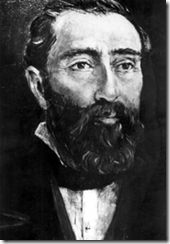
Although he was known in his day, which was the early 19th century, as the “King of the Minorcans,” Pedro Benet was a different kind of Minorcan. In St Augustine, when you say “Minorcan,” you are referring to descendants of the people brought here by Turnbull in 1765. But they were not all Minorcans, strictly speaking, because some were from Italy, particularly Sicily and Sardinia, and others were from Greece. Turnbull’s wife was Greek, and the Mediterranean voyage was her idea because she thought that Greeks and others from the region could tolerate the heat better than the usual English or Irish laborers.

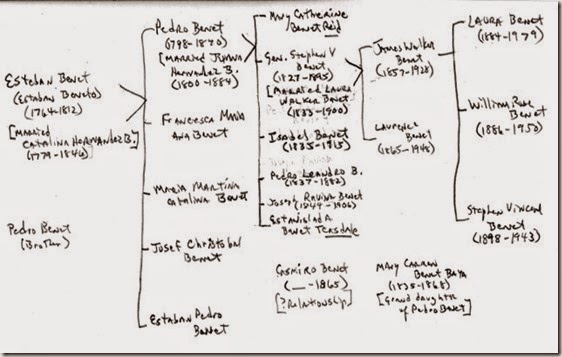
However, Pedro Benet’s family actually came in at a different moment, and they came directly from Minorca and had nothing to do with Dr. Turnbull. Pedro Benet’s grandfather, Esteban, was the first to appear in St Augustine, and arrived around 1785, some 8 years after the New Smyrna Beach Minorcan march to St Augustine.  He married a Hernandez, a member of one of the few Spanish families to remain in Florida during the British Period.

Below is a drawing of Pedro Benet that Nick found in his researches.
image

On this basis, Nick developed a very detailed history for the family, which was a very important one in Florida history, and included many people active in government and public affairs in Florida. It also included Stephen Vincent Benet…the first Florida graduate of West Point.

And it includes the Stephen Vincent Benet who probably first came to your mind, his grandson, born not in St Augustine but in Pennsylvania, the writer who gave us John Brown’s Body, the wonderful poem American Names, and my childhood favorite short story, The Devil and Daniel Webster. Anybody who remembers the soul of Jabez Stone fluttering in the handkerchief will know where the inspiration for the 1950s movie “The Fly” came from…although I’m still not sure why the story was  my favorite!

Nick collected wonderful information, and we are currently looking for a way to store all of our information on line so that it can be accessed easily by anyone. However, since we don’t have the archive yet, let me post the truly excellent genealogical chart that Nick drew up, which traces the branch of the Benet family that produced Stephen Vincent Benet and his literary siblings:
IMG_0003

And now let’s get back to “Minorcan” in the St Augustine sense of the word.

The reason Tolomato came back into use as a cemetery, after its initial period as an Indian village which had its own church and probably its own cemetery, was because the British governor Patrick Tonyn allowed Fr. Pedro Camps (his statue in the Cathedral courtyard can be seen below) and his band of Minorcans to use it as a cemetery after they arrived in St Augustine on their flight from the New Smyrna Beach indigo plantation.

IMG_0132

When the Spanish returned, it became the parish cemetery for what is now the Cathedral, but the great majority of the people buried there are descendants of this first group of Minorcans (including Greeks and Italians) who arrived in St Augustine after rebelling against Dr. Turnbull. So St Augustine Minorcan names can be very varied, ranging from the pure Catalan name Camps to the Anglicized Masters (Mestres, in Catalan), and including some that are clearly of Italian origin and some that are of Greek origin. And these people, many of whom married into the few Spanish families that stayed in Florida during the British period, such as the Hernandez family, the Sanchez family and the Solanas, are the foundation of our modern city.

So it was very fitting that members of the TCPA board went to Menorcan Society president Carol Lopez Bradshaw’s house to receive the generous $5,000 pledge that the Menorcan Society had made to the cemetery fence fund project. Carol is descended from several Minorcan families, as are the other members, and they worked hard at their festivals and events over the past year to collect this pledge. The highlight of the last St Ambrose Festival – many Minorcans live in that rural parish – was the raffle of a Minorcan cast net, made in the traditional style by a local Minorcan craftsman, for the benefit of the cemetery fund.

So below we see the Menorcan Society treasurer, Theresa Usina, handing the pledge check to Elizabeth Gessner, TCPA president, flanked by Janet Jordan, TCPA treasurer. Behind them are Glenda Frawley, Menorcan Society VP, Louise Kennedy, who is the TCPA secretary, and Carol Lopez Bradshaw, Minorcan Society President.

IMG_0188

Many, many thanks to the Minorcan Society! And our readers are getting a heads-up: there will be a special event in November commemorating the Minorcan March to St Augustine from New Smyrna Beach. You’re the first to know, and details will come out in the next couple of months, so keep watching!

Tuesday, April 7, 2015

Walking St Augustine…from Tolomato.

As every blog reader knows, Tolomato Cemetery is located at the very start of the Historic District, at the north end of the city near the old City Gates (below) and the modern Visitors Information Center and Parking Garage. So it’s a perfect place for beginning your stroll through historic St Augustine, moving between past and present.  IMG_0094  But it just got even better!  Elsbeth “Buff” Gordon, the architectural historian and writer who has given us Florida’s Colonial Architectural Heritage and Heart and Soul of Florida: Sacred Sites and Historical Architecture, has just finished her new book, Walking St. Augustine.  The author is a familiar presence in St Augustine and has worked on many archaeological and historical projects. 
 This is a much needed pocket guide to St Augustine, published by the University Press of Florida and sponsored by several Florida historical organizations and several years in the making. It is based on a set of manageable walking tours that will take visitors through the downtown historic districts and tell them all the insider details about the buildings and their builders or former residents.  And, best of all, she’s presenting the book at Tolomato Cemetery on our next Open Day, Saturday, April 18, 2015.  Below is the already dog-eared copy we have at the cemetery…  IMG_0096[1]  Buff Gordon will be at Tolomato all day from 11-3:00 pm to meet visitors and sign books, and she will also give a special presentation at 1:00 pm.  This would be a great time to buy the book (about $15.00...and you know you’re going to buy it sooner or later anyway) because the author is generously donating all proceeds to the Tolomato Cemetery Fence Fund for the replacement of the horrible fence seen below.  IMG_2136  And since many of the people whose homes or properties appear in Walking St. Augustine are  buried at Tolomato Cemetery, we’re going to be doing some special tours focusing on a few of them, such as Fr. Miguel O’Reilly, whose vault is shown below, and who is  connected with the O’Reilly House on Aviles Street, and Mary Darling, who taught at the Oldest Schoolhouse right around the corner on St. George St.  Then visitors can take their signed copies of the books and go on a special kind of "scavenger hunt" and find the site in question, based on the excellent maps, directions and photos in the book.  
There will also be music and…refreshments will be Girl Scout cookies, including Thin Mints!  Don’t miss it!