Thursday, September 20, 2012

Metalwork Preservation

Tolomato Cemetery has a number of cast and wrought iron grave enclosures – or at least what’s left of them!  As you can see, they have rusted through, fallen over or been disrupted by plant life.

IMG_1820

But we’re going to attempt to halt the deterioration. Matt Armstrong, our Preservation Chairman, attended the NCPTT workshop on historic ironwork a few months ago, and now he’s going to bring his knowledge to bear on Tolomato’s collapsing ironwork.

IMG_1832

On October 6, we’ll have another Preservation Work Day for our members and volunteers, where they’ll clean, remove rust, repair what can be repaired, and use rust-proofing paints and materials to prevent further loss of these features, some of which are very lovely examples of 19th century cemetery art.

IMG_1835

Friday, August 31, 2012

Our 16th Century Burial

Earlier this year, we reinterred bones from the burial place of some 16th century St. Augustinians found during an archaeological dig at the site of the first St. Augustine parish church, Los Remedios, on what is now Aviles Street.

We planned to mark the site with a piece of coquina (which may have originally have come from the Tolomato belltower) and a brass plaque.  And here it is.

Plaque

Lux Perpetua is Latin and means “Perpetual Light.”  It is from the old Latin funeral rite, and the full phrase was  Requiem æternam dona eis, Domine: et lux perpetua luceat eis. The translation is Eternal rest grant unto them, O Lord, and let perpetual light shine upon them.

Sunday, August 26, 2012

The Cathedral Bells–and Tolomato?

The Cathedral Basilica of St Augustine has embarked on a renovation and restoration program this year, and the first project was getting the Cathedral’s many bells to ring again.  There are two sets of bells, one set in the free-standing Flagler bell tower near St George Street, which was added in the 19th century after the 1887 fire, and the four original bells in the campanario or espadaña (a traditional Spanish false-front bell-wall) over the door. 

Cathedral Front

The bells have not rung for years, although the four original bells, which had been damaged in the 1887 fire, had been recast and rehung for the 400th Anniversary in 1965.  But for one reason or another, they were not used, possibly because no adequate ringing mechanism was in place.  In the 19th century, they were rung by being swung with ropes – or by little boys who would climb up to a platform behind them and strike them with a hammer!  Obviously, it’s time for something more modern. 

The mechanism that rang the Flagler bells had also ceased to work and they placed too much of a strain on the bell tower if they moved, so an electronic chime replaced them years ago.  But now something has happened.

Louise and Bells

Here we see Tolomato Cemetery Preservation Association Secretary Louise Kennedy, standing in front of the bells as they are placed on a truck to be taken away for cleaning and restoration.

What is the connection with Tolomato?  As we know, Tolomato was originally the site of a Franciscan Indian mission, which had a four-story coquina bell tower that remained standing until sometime between 1793 and 1800, when it was slowly taken apart so that the stone could be used in the building of the current Cathedral. 

When the Spanish left Florida in 1763 as the British arrived, they took with them to Cuba all of the church furnishings from all of the churches, including the missions such as San Sebastian, and of course the parish church, which was at that time Nuestra Senora de la Soledad on St George Street. In the inventory done upon the arrival of the goods in Cuba, there is a record of three bells, “one large, one medium and one small,” being brought to Havana.  Most of these goods were distributed to other parishes in Cuba or to the new one founded by St Augustine residents in Guanabacoa. Only a few things were returned to St Augustine when the Spanish came back in 1784, and the bells were not mentioned on the list that I have seen.

So it seems that three of the current bells were acquired for the building of the new church, the current Cathedral. Construction had actually been planned some 10 years earlier, but the funds needed to be used for rebuilding the town after a disastrous hurricane. However, it is possible that the bells had been ordered at this time, because when they were taken down, one was found to be dated 1787.

But what about the fourth bell?  The oldest bell, dated in 1689 and named San Jose, is possibly the one that came from Tolomato. It’s the one at the lower left in the bell tower, and is not the largest.  Below is a photo taken by Louise.

Bell removal 099

Bells were very important to the missions and to the town.  Life began every morning with the Angelus at 6:00 am, and the Angelus bells rang again at noon and at 6:00 pm, marking the day. It is certainly possible that this bell was somehow left in the bell tower at Tolomato, of no interest to the British, or perhaps was hidden elsewhere and recovered by the Spanish when they returned.  Will we ever know?  Well, rest assured that we’re certainly trying to find out!

Monday, July 23, 2012

Two years, 5000 Visitors!

We were open last Saturday, and we had 306 visitors, including a couple who flew down from Pennsylvania just to visit the cemetery.  So then I got to thinking…and I realized that, averaging it out, Tolomato Cemetery has had about 5,000 visitors since our start-up in the Summer of 2010.

Pretty impressive!  Below is a photo taken by Louise Kennedy of some of our visitors – from another century. Dressed in period dress are DAR and Garrison members at the tomb of Fr. Miguel O’Reilly; behind them is the marker for Don Juan McQueen, which the DAR installed with the help of these gallant gentlemen.

reenactors

And here are our docents, including Nick McAuliffe, who was undeterred  by his recent broken ankle and even came by on crutches to sit by the gate for awhile, and Mary Jane Ballou, who played the harp in the chapel all afternoon.

nick

Thursday, July 19, 2012

Tolomato on NPR


NPR’s Greg Allen recently came to St Augustine to visit Tolomato as part of a summer program series entitled “Dead Stop,” which is, naturally, about various historic cemeteries throughout the US that might make an interesting destination for a visit. Well, at least a temporary destination.

He interviewed a couple of TCPA members, Elizabeth Gessner and Nick McAuliffe, and spent the morning rambling among the graves and learning about the fascinating historical figures who are buried at Tolomato.  He had clearly done his homework and was a good interviewer, and the resulting short program gives visitors an intriguing little glimpse of Tolomato.

Nick McAuliffe took this photo of Greg Allen, Elizabeth Gessner and Matt Armstrong after their visit to the Varela Chapel.

NPRInterview1

To hear the program, go to http://www.npr.org/2012/07/10/156520481/a-citys-history-writ-small-in-one-cemetery.

Sunday, June 24, 2012

June 22 Torchlight Tour

The TCPA members-only event began after a day spent anxiously watching the weather.  We got rained out last year – but fortunately, it didn’t happen again this year, and not a drop fell during the Torchlight Tour we had planned as a gift to our members and to the City of St Augustine.

The brave folks at the gate fending off the ghost tours and receiving the guests – our treasurer Janet Jordan, with her law enforcement brother Paul Jordan providing a firm presence while his wife, Debbie Jordan, also checked off guests – deserve particular mention for keeping everything orderly and smooth. The cemetery would have been the most crowded spot in St Augustine otherwise, particularly when passersby saw the torches lit and the docents in their period garb.  Janet and Debbie didn’t have to wear period dress…this year…

photo 11

Priscilla de la Cruz greeted guests and roamed the cemetery taking the photos that you see on this page. 

Mary Jane Ballou heroically played the harp for hours, giving guests a medley of Spanish, English, French and American music of the 18th and 19th centuries.
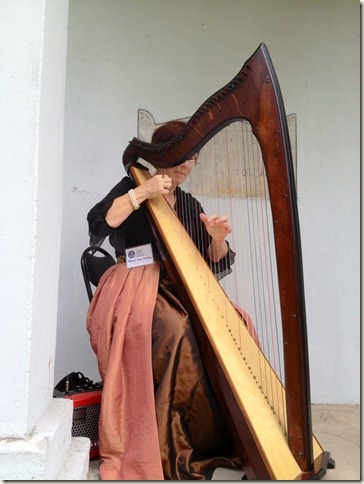
photo 6

When the guests were all assembled, Elizabeth Gessner welcomed them and introduced Carl Halbirt, City Archaeologist, who gave a talk and explained our newest and oldest burial: that of the 16th century St Augustine citizens, possibly priests or people important in the Church whose remains were found during an archaeological dig on Aviles St.

edg3

The text on the new marker is visible behind Mary Jane and Elizabeth. The plaque is not ready yet, but the remains were reinterred at Tolomato Cemetery on June 16 by the Cathedral’s pastor, Fr. Tom Willis, and there is a piece of coquina from the Cathedral marking their location.
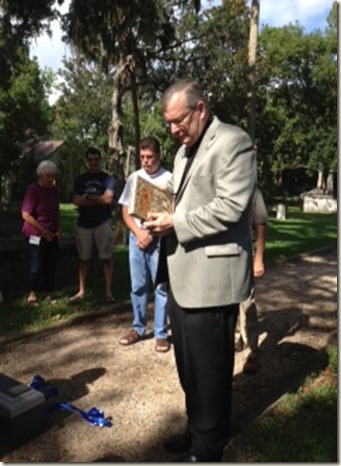
fr tom

When Carl finished, John Cipriani, 18th century Spanish soldier, led the guests off by lantern-light to the 5 stops on the tour. He was as always an impressive figure and he came to us at Tolomato event though he had spent the entire day filling 750 rounds of shot and I don’t recall how many cannon rounds for the Fort Mose reenactment scheduled for the following day.  In this photo, he’s taking an 18th century photo of Mary Jane with his 18th century IPhone…well, maybe not.
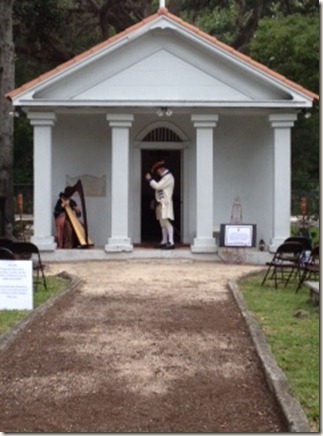
edg4

Our great docents, Sue Barrow, Sue Howden, Louise Kennedy, Carol Lopez and Sister Thomas Joseph McGoldrick interpreted, respectively, Don Juan McQueen, Elizabeth Forrester, Bishop Verot, the Minorcans and the Sisters of St Joseph.  Here you see Sue Howden, Carol Lopez and Louise Kennedy, getting ready to take their places.

6-21-12 Tolomato 002

Carol was at the first stop on the tour and she made it all real to people by pointing out the Minorcan names and their connections with St Augustine here and now. Pedro Benet’s marker was illuminated and she recited part of the beautiful poem by Stephen Vincent Benet (American Names) which speaks of the “singing names” of the Minorcans.

photo 1

Our soldier then led guests to the next stop.

Sue Howden told Elizabeth Forrester’s touching story and recited the sad inscription on her vault, and then we had an unexpected treat when Dianne Jacoby and her troupe of reenactors came in and stood next to Sue at the tomb and did their interpretation of Elizabeth’s mother and sister lamenting her death. This is something they have done elsewhere, and it was a very dramatic moment for our guests.

photo 2

At the Verot tomb, Louise Kennedy gave guests a clear and dignified introduction to our first bishop, and then Sister Thomas Joseph McGoldrick, SSJ, accompanied by Sister Joyce, interpreted the site that marks the burial place of two of the original eight French sisters brought to St Augustine by Bishop Verot. Sister Josefa, SSJ, had found photographs of the two sisters, who died in the late 1860s within two years of arriving here, and Sister Thomas Joseph displayed them to the group. I had never seen the photos before, and we need to put them in our archives.  Alas, I don’t have any pictures of this stop, but perhaps one of our visitors will supply me with some and I will post them later.

photo 4

Then guests proceeded to our next site, the new Don Juan McQueen marker, where Sue Barrow, the great-great-great-great-granddaughter of John McQueen, told us about her illustrious forebear. Incidentally, she made her own 18th century English garb, which you see above, based simply on drawings that she saw on websites - and she did it in under a week. I think she may have a new career awaiting her…
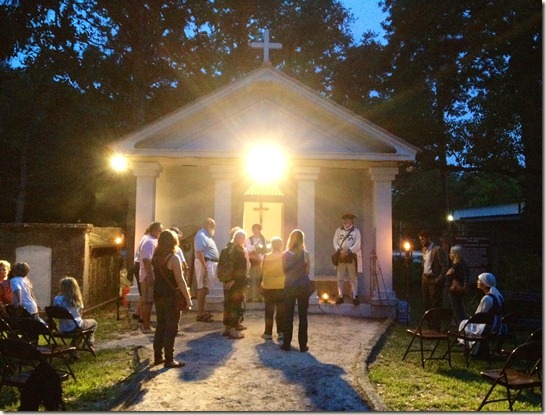
photo 5

Finally, John Cipriani and Matt Armstrong (visible in the upper right) led the group to the Varela Chapel, where Elizabeth and Matt said a few words about Fr. Varela and the building. As you can see, it is a dramatic sight by torchlight (although I have to admit that much of the illumination in this photo came from the security lights on the roof). The interior was lighted by candles, just as it would have been in 1853, and the glow spread out into the night to bring this event to a wonderful close.

Monday, June 18, 2012

New Look for Tolomato Docents

The cemetery was open last Saturday and this time our visitors got something different: several of our docents had gone off to St Augustine Textiles on St. George Street and got themselves great new “old” outfits.

We’re preparing for our membership event this coming Friday, June 22, and one of our docents suggested wearing period clothing. The idea caught on and several of us went and got our outfits last week. Of course, we couldn’t wait until the 22nd to wear them.

Below are Louise Kennedy and Elizabeth Gessner, women of 18th century St Augustine (with what must be an 18th century I-Phone visible in the corner of the photo!).

reenactors