Sunday, August 25, 2013

Quik Clean and Stealth Opening

Since we didn’t open the cemetery last Saturday (a 3rd Saturday) because of horrible weather about an hour earlier, we decided to open yesterday.  This time, we combined preservation and historical tourism:  one group worked on cleaning or restoring different sites, while another group tended to the table at the entrance and welcomed visitors.

During the 2 hours we were open, we got about 75 visitors, all of them very happy to discover that the cemetery was open.  Tours were on an irregular, as-needed basis, but visitors also had more time to ask for an in-depth explanation of different aspects of the cemetery, and several of us spent more than 30 minutes each with different interested visitors.

Meanwhile, others labored as you see below, where Patti Kelbert (owner of Le Pavillon) takes a wire brush to one of the posts on the Hernandez enclosure.

IMG_2622.JPG (2)

Missing are photos of Bob Kennedy, carefully weeding every square centimeter of the Benet enclosure; Mary Jane Ballou helping Priscilla de la Cruz clean out the dreaded area behind the chapel; Louise Kennedy leading people around; Nick McAuliffe and Janet Jordan and Bob taking the truck out to pick up crushed shell for covering the enclosures that Priscilla de la Cruz weeded (see below). But that all happened, and it was a really nice day for all.

IMG_2621.JPG (2)

It was so much fun that we’ve decided that in the future, we’re going to combine preservation with interpretation, and we hope to get some people out to work on different things while others lead tours.  Or they can trade back and forth!

If you’re interested, get in touch (board@tolomatocemetery.com).

Thursday, August 22, 2013

Home Repairs

Everybody – the hardworking TCPA volunteers and docents in particular – will be very happy to know that we got the gate fixed up today.  Steve from Brock Fence came out and rehung it with new hardware, straightened the barbed wire and the chain link, put in a drop post so we can close half of it at a time, and in general made it a functioning gate again.  No more will it take three people to get the gate closed after our Open Day!

IMG_2616.JPG (2)

Steve did a great job and this is going to be a big improvement.  We’re planning on replacing the entire gate, of course, but that’s a project that won’t happen overnight.  In the meantime, we’ll enjoy our “new” gate – which was probably first installed over 60 years ago, in the 1940s or 1950s.  So all things considered, it hasn’t done a bad job.

Below is the new drop bar and hook. This may not look very exciting, but if you’ve ever had to hold one half of the very heavy and crooked gate closed with your foot while attempting to capture the other part with the chain and padlock, you’ll appreciate how wonderful this is!

IMG_2617.JPG (2)

Sunday, July 28, 2013

Preservation Madness!

We went wild at the cemetery this weekend! In the space of only 3 hours, a team of about 15 people restored a cast iron gate, cleaned innumerable markers, and stripped out all of the ugly, stone-destroying weeds that were threatening the health and well-being of the vaults and markers.

Below are some great photos taken by Nick McAuliffe:

Here we see  the Hernandez enclosure, missing the gate - which Matt Armstrong removed to make it easier to clean.

P1100339

Nick discovered that the enclosure had a brick sill.

IMG_2495.JPG (2)

Matt shows the group how to work on the gate, which was very rusted and had actually been face down in the grass for many years.

P1100344

We brushed it with wire brushes and cleaned off all the flakes, as you see Matt, his parents and Patti Kelbert doing here.

P1100364

Matt then sprayed it with Rust Reformer, which reverts the rust process and gives it a smooth surface again.

P1100367

Next was the primer coat. All the paints are oil-based. It’s time consuming because there are so many nooks and crannies.  But many hands make light work, including my hand on the bottom, wearing the keychain.

P1100383

Then we applied the black top coats, as we see Moses Stzylerman, in his suitable skeleton outfit, doing in this photo.

IMG_2534.JPG (2)

Finally, we put it away to dry.  Rain was coming in, so we had to hurry. But we’ll hang it next week.

IMG_2539.JPG (2)

Meanwhile, the other volunteers powered up and swept through the cemetery.  Here Priscilla cleans an enclosure, aided by Mary Jane, Janet and Moses.  Way in the background are two new volunteers, Sharla Fenchel and her daughter, going off to work on the mysterious tomb of “T.H.” at the very southeast corner of the cemetery.  It’s never too late to be a new volunteer!  You learn on the job.

P1100369

Louise and Bob Kennedy removed lichens and aggressive plant-life throughout the cemetery.

IMG_2517.JPG (2)

We close with a photo of Bob, managing to win the war (at least temporarily) on all of that ugly stuff that grows on top of the Sanchez vault.  Congratulations to everybody!  Way to go!

P1100370

Monday, July 22, 2013

Legoland meets NOLA

The tireless Nick McAuliffe, TCPA Vice President, was in San Diego to visit his grandchildren a couple of weeks ago.  He and his wife, Cynthia, took the kids on the obligatory visit to Legoland, which is just north of San Diego, and found that it was displaying Lego models of several important cities, among them, New Orleans.

And with his unerring sense for finding cemeteries, lo and behold, he found the famous St. Louis Cemetery #1, Lego version, in an appropriate place in the miniature French Quarter of the Lego NOLA.  It even appears to feature a funeral procession heading down the street!

LegoPix

Nick relates that he checked the Paris reconstruction for signs of the Pere Lachaise Cemetery, but had no luck...

Thursday, July 11, 2013

Preservation at the Continental Divide

I'm in New Mexico right now, near the Continental Divide and far away from St Augustine and Tolomato. But never really far away - I was thinking about our upcoming preservation work day (July 27, lest you forget!) and about the cleaning of the headstones and inscriptions in particular.

These are always hard to manage. If you clean them too much, the inscriptions become illegible. If you scrub the too hard, they wear away. And if you don't do anything, lichens  and acid from tree run-off attack the stone and they flake off or the stone degrades and they disappear.

But our problems are nothing compared to El Morro National Monument, where they have inscriptions (in this case, "historic graffiti") dating back to 1605, from the time of the first Spanish expeditions through the Southwest.  Inscriptions continued during the following US period and both were frequently engraved next to pre-European petroglyphs left much earlier by the various Indian groups (the Pueblos and the Zuni).

"Morro" is the Spanish word for headlands or bluff (or the snout of an animal!), and describes this magnificent sandstone crag that rises 800 feet above the already nearly 8000 foot altitude of these mountains, not far from Gallup.  At the foot of the cliff is a pool of fresh water, run-off from the snows and rains of this area, which has apparently always attracted human beings in this barren, harsh environment. At the top of the crag was a pueblo, nearly inaccessible from below and thus secure, with residents descending from the peak to bring up water. After the time of the Indians, Spanish expeditions and then later US pioneers and military expeditions also stopped here.  Below are some Indians carvings, also known as petroglyphs.


All the different passers-by left their marks.  Juan de Oñate, explorer of the Southwest and the Pacific coast, left the first European inscription in 1605 as he returned from his search for  the "South Sea" (he reached the Gulf of California and the Pacific).  The inscription is below and records these facts in his own hand.  And behind him came many soldiers, friars, governors, and even the occasional bishop, all of whom stopped to inscribe their dates, their names and their missions.  I was particularly struck by the fact that many of them even engraved their "rubrica," that is, the distinctive flourish that Spaniards still use to authenticate the document as their own.  

To give you a sense of scale, in the photo below, I am pointing at the Oñate inscription and the petroglyph shown above.

When the US took over New Mexico as a territory in1847, US expeditions - either to fight or make treaties with the Indians - made their way last this point. In 1849, LT. J. H. Simpson and a military artist, R.H. Kern, returning from making a treaty with the Navajos, took it upon themselves to transcribe all the Spanish inscriptions.  Their record of their work, which they engraved on the north wall, is the first in English. It also contains a spelling error - "insciption" instead of "inscription," but stone is unforgiving and  at that point, correcting it would have been more trouble than it was worth.


Carving on the wall was halted in1906 when the National Parks system was established, and following that, various attempts were made to preserve or even improve the readability of the original graffiti. The reason that Oñate's words stand out so much is that in the 1920s, some of the older inscriptions were darkened with graphite (that would be a #2 pencil) and later some were filled with other substances. But in 1924, attempts were made to clean off some off the more modern inscriptions, considered of no historic value, by rubbing them out with a piece of sandstone. Unfortunately, some of the important inscriptions were erased,too, among them that left by the famous Archbishop Lamy, the subject of Willa Cather's work, Death Comes For the Archbishop

Currently, preservation consists mainly of protection. There's really no way to preserve a perishable material like stone forever. The fact that these have endured for 400 or more years is something to be grateful for, particularly now that we have the technology to record them and to recover earlier descriptions of them. And maybe that's really all that can be done, particularly because there are many things beyond our control in an outdoor environment, such as a cliff face - or a cemetery.  


In fact, I was not even able to see all of the inscriptions because just a few hours before my visit, a rock fall had closed part of the pathway and the rangers were still evaluating the damage done to the graffiti. There hadn't been a rockfall there for decades, but that is certainly no guarantee that it will never happen, and another rockfall was inevitable. And so are more in the future, some of which will no doubt damage or destroy these inscriptions.

Preservation is all important - but sometimes this doesn't mean preserving the actual item (which is it always possible or even never possible) but instead an accurate record, particularly now with the great techniques we have for doing this.


Wednesday, June 26, 2013

Preservation Day Coming Up July 27!

We’re getting ready for a nice, hard-working morning of preservation tasks on July 27 (9 a.m.-12 noon, hopefully before it gets too hot to work!).  We’re planning on tackling the metalwork again, this time on one of the prettiest features of the cemetery:  the gate to the Mary Hernandez enclosure, which features two lambs resting under a weeping willow tree.

IMG_2996

Lambs and weeping willows appear frequently in 19th century cemetery art. There appear to be two birds, probably doves, in this gate as well, and doves were also a frequent feature.

IMG_2999

As you can see, the metal is covered with rust and has gotten pitted.  But we can fix that! 

Below you see a piece of the metalwork on the Benet-Baya enclosure. It’s in an unrestored state:  pitted and covered with rust and concretions of rust.

IMG_2992

Here’s an identical piece on another part of the enclosure, after careful wire-brushing, brushing, sealing with a rust reverser, and several coats of primer and paint:

IMG_2993

It’s a time-consuming process, but the results are great and the treated pieces will be preserved for many years.  So come out on and join us on July 27 when we work on the Hernandez gate.  We also plan to rehang the gate, which as you have probably noticed, is simply propped in place on the ground.

No experience necessary!  We provide the materials, although you might want to bring your own work gloves and eye-protection.

Thursday, May 30, 2013

De Mier–St Augustine’s Connection with an Historic Spanish Family

  In April, we cleaned a ledger stone belonging to Antonio Jose Fernandez de Mier, a St Augustine resident who was born in Cádiz, Spain in 1775 and died here in 1825.  Wondering if he was connected with Fray Servando de Mier, considered one of the fathers of Mexican independence, I stumbled across fascinating information about this family, which is important in both Spain and Latin America.
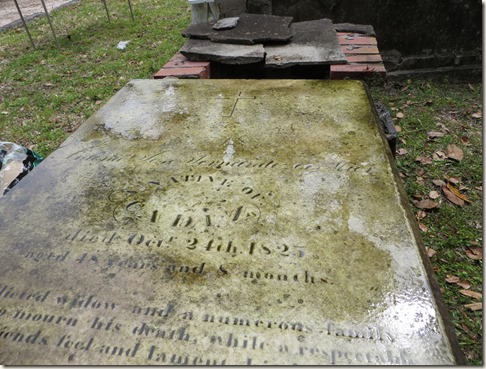
 De Mier Vault
The name is that of a very old and historic family, originally the Vela Ximénez family, descendants of the Dukes of Aquitania, who came in the 9th century to the area now known as Navarra, now a part of Spain, but at that time under the control of the French Dukes of Aquitaine (as a point of reference, this is the region that includes modern Toulouse). The family became the Dukes of Álava, a region currently the subject of dispute between Navarra and País Vasco. Incidentally, most of the royal houses of Europe are related to the Dukes of Aquitaine.

13thcent

After being involved in the usual power struggles that were a daily feature of life in the warring kingdoms making up Spain, several family members sided with the rulers of León (see above map of 13th century Spain) in their fight against the neighboring kingdom of Castilla. But they had to flee after one family member murdered – in the Cathedral - the heir to the throne of Castilla. They took off for the remote mountains of the areas now known as Asturias and Cantabria. They settled in the town of Mier, located in a remote mountain valley in the jagged mountains now called the Picos de Europa, next to the River Cares.

. Mier
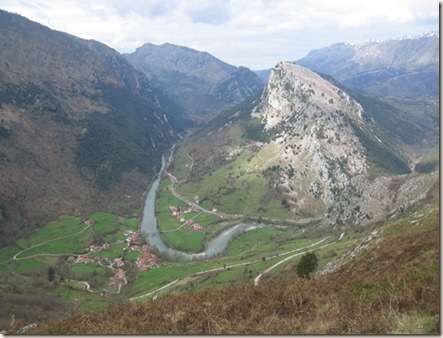
The name of the town probably comes from the Latin or Romance word messis (mies in modern Spanish), which meant harvest or crop, usually of grain. The tiny town itself in in a narrow part of the valley, but is located in the area of the common lands where the inhabitants of the valley cultivated their big crops, such as grain. Nowadays it devotes itself to cheesemaking, and cheeses from Peñamellera Alta, the name of the region, have their own denomination of origin.

Queso

Taking the name of the town as their own, the de Mier (“from/of Mier”) family became one of the most important families in Spain and Latin America and one that is still influential today. The ancestral homes of the de Mier family can still be visited in Mier, as well as parts of Cantabria to which some members relocated. There are several branches of the family, but certain things, such as the fleur de lis, are common to their various coats of arms. The fleur de lis indicates the Aquitanian origin of the original family.

In the 13th century, the Ximenez family, soon to become “de Mier,” were given the privilege of having the Cross of St Andrew as part of their coat of arms. It symbolized their participation in the decisive Battle of Las Navas de Tolosa in 1212, fought on St Andrew’s Day. This was a significant victory in the fight to expel the Muslim invaders from Spain, a fight which actually began not far from Mier, in those same mountains in the year 722, about 10 years after the invasion. The Asturians were the first to successfully resist the invaders and the fight continued for centuries, moving from the north to the south until the decisive defeat of the Arabs in Granada by the troops of Ferdinand and Isabella in 1492. The Cross of St Andrew is also the “X-like” cross that appeared on the Spanish battle flag that flew over Spanish St Augustine.

But over the generations, different elements were added or dropped. Below is a de Mier coat of arms that appears on many buildings in Mier. Their motto can be roughly translated as: “Forward, man of Mier, because you are the bravest.”

 De Mier

Because they were hidalgos (nobles) registered in the Asturian records of “hidalguía” (nobility) based on their ancestry, de Mier family members were important in their region and were traditionally involved in politics and the judiciary. Many members of the de Mier family in Spain are still involved in scholarship, law or politics, both in Asturias and in other parts of Spain to which this large and ancient family scattered. And of course, they are still marrying into other families: the grandmother of Rainier III of Monaco is a de Mier.

The four main branches of the family in Latin America are the de Mier-Teran, de Mier-Noriega (in Mexico), de Mier y de la Torre (Colombia) and de Mier y Arce (Peru). Fernandez de Mier is thought to be one of the oldest forms of the name. Part of this family went to Andalusia in the 18th century and settled in Cádiz, where they became successful merchants. From the 19th century onwards, they built a trade empire on dealings with the Spanish Caribbean (of which St Augustine was a part).  Antonio Jose Fernandez de Mier came from this family, since the inscription records that he was born in Cádiz, like his father.

We’ll devote another post to more information about Antonio Jose Fernandez de Mier and his connections with the Micklers (a family that emigrated to South Carolina from Alsace, France in the 18th century, and then on to St Augustine in the late 18th century) and with several Minorcan families, such as the Andreu family.

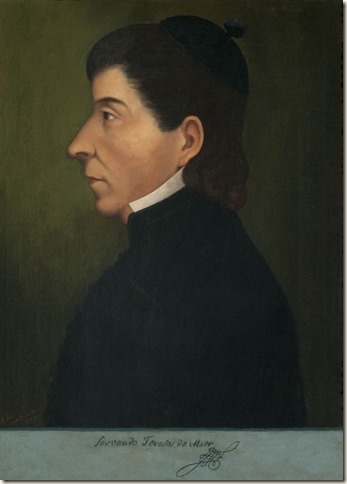
But for now a bit about Fray Servando Teresa de Mier, who started my search.
Servando-Teresa-de-Mier

The rather firm looking gentleman in the photo was a Dominican friar, born in Monterrey, Mexico in 1765. His family lived in an area known as Nuevo León, in the northern part of the country which at one point could have been part of Texas, where there is even a town named Mier.

Fray Servando de Mier led a colorful life that started with his being exiled from Mexico to Spain because of his theory on Our Lady of Guadalupe, specifically, that the image did not appear in the 16th century but had been done in the 1st century when Saint Thomas, on his way to India, visited the Latin American continent and evangelized the Indians. It is certainly likely that St Thomas did get to India, but completely impossible that he would have made it to Latin America. But don’t forget that Columbus thought he was looking for and had arrived in India, probably leading to this theory.


Virgen_de_guadalupe1

Fray Servando de Mier had been exiled to Cantabria, the family’s ancestral home, but this was just the beginning for him. He got into political trouble virtually everywhere he went, since he was an early defender of the idea of independence for Spain’s Latin American colonies, particularly Mexico. During his exile, he was imprisoned for his political opinions, went to Cádiz, which was a hive of revolutionary activity, was seized by the French and spent time in Paris, somehow ended up in Rome, went back to Spain and back to various forms of imprisonment, and finally fled to London. While he was there he met a fellow Spaniard who was very involved in Latin American independence movements and they returned together to Mexico in 1822, during its War of Independence. Imprisoned again, but briefly, he finally had the pleasure of being part of Mexico’s constituent congress for the writing of the Mexican Constitution. He died in 1827 and was buried in Mexico with great honors.

However, it doesn’t end there: by 1861, he seems to have been more or less forgotten, because his remains were exhumed, along with other burials at the same location, and were sold to an Italian who exhibited them as “victims of the Inquisition.” (They weren’t.) Finally these remains ended up in Belgium, and now nothing is known of their whereabouts. So Fray Servando de Mier was as dramatic (and perhaps as much of a traveler) in death as in life.